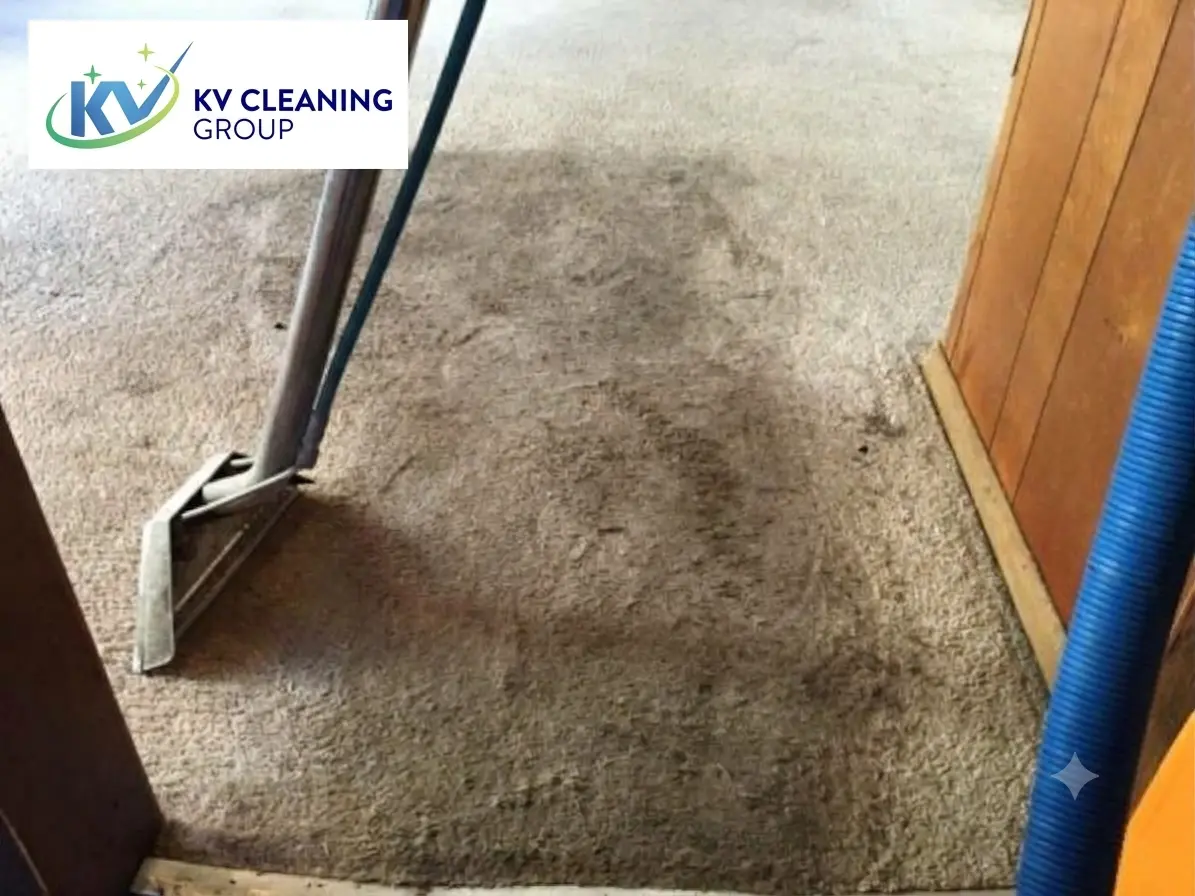
A carpet can be clean and still look worn.
This is especially noticeable in entrances, reception areas, corridors, lift lobbies and walkways where people follow the same routes every day. The carpet may have been vacuumed regularly and professionally cleaned, yet certain sections still look darker, flatter or less textured than the surrounding floor.
That does not always mean the carpet is dirty.
Sometimes the main problem is pile compression.
Repeated foot traffic pushes carpet fibres down. Over time, the pile can lose some of its height and definition, creating visible traffic lanes. Dirt and grit can make the problem worse because they increase abrasion between the fibres and footwear.
The good news is that some flattened carpet can improve with proper maintenance and cleaning.
The important word is some.
Not every flattened area can be returned to its original condition. The result depends on the carpet construction, fibre, pile, age, amount of traffic and whether the change is temporary compression or permanent wear.
So before replacing the carpet, it is worth understanding what is actually happening underneath your feet.
Why Does Carpet Become Flattened in High-Traffic Areas?
Carpet pile is designed to withstand repeated use, but it is not immune to compression.
Think about a commercial corridor.
Hundreds of people may walk through the same route while taking almost exactly the same path. Over weeks, months and years, the carpet receives repeated pressure in the same locations.
This can create:
- Flattened pile
- Loss of texture
- Darker-looking traffic lanes
- Matted fibres
- Reduced pile definition
- Uneven appearance
- More visible soil
- A worn appearance around entrances and corners
The effect can be especially noticeable where people turn rather than simply walk straight.
For example:
Entrance → reception desk → lift → corridor
may create a visible path across the carpet because the same route is used repeatedly.
The Carpet Institute explains that carpet maintenance needs to consider traffic volume and that concentrated walking areas require greater attention than lightly used areas. Carpet Institute
Flattened Carpet Does Not Always Mean Dirty Carpet
This is one of the most important things to understand.
A flattened carpet can have two separate problems happening at the same time:
Appearance change caused by soil
Dirt, dust and grit can make carpet look darker and more worn.
Appearance change caused by compression
Repeated pressure can push the pile down and change its texture.
These problems need different responses.
If the main issue is soil, cleaning can make a significant visual difference.
If the main issue is compression, cleaning may improve the appearance but cannot necessarily recreate the original pile height.
That is why simply saying "the carpet needs a deeper clean" is not always accurate.
First identify whether you are dealing with:
soil + compression,
compression alone,
matting,
wear,
or another appearance characteristic.
What Is Carpet Crushing?
Carpet crushing refers to a loss of pile thickness caused by pressure or traffic.
In a commercial building, this can happen gradually.
The carpet is repeatedly compressed by people walking across it, and the fibres may not fully recover between periods of use.
The Carpet and Rug Institute defines crushing as a loss of pile thickness caused by traffic and distinguishes between restorable and non-restorable changes. The Carpet and Rug Institute
This distinction matters.
If the pile can still recover, appropriate maintenance may improve the appearance.
If the fibres have suffered permanent damage or significant wear, cleaning cannot rebuild the missing material.
Why High-Traffic Routes Look Different From the Rest of the Carpet
Imagine two sections of the same carpet.
Section A
A meeting room used twice a week.
Section B
A corridor used continuously throughout the day.
Both areas may have the same carpet.
But they are not experiencing the same workload.
The corridor receives repeated compression, while the meeting room receives relatively little.
This creates an uneven appearance across the same installation.
Common high-pressure locations include:
- Main entrances
- Reception areas
- Lift approaches
- Corridors
- Stair approaches
- Break-room entrances
- Walkways between departments
- Retail aisles
- Waiting areas
- Frequently used meeting-room entrances
The Carpet Institute also recommends that commercial carpet maintenance be planned according to actual traffic rather than applying one identical cleaning schedule to every area. Carpet Institute
Dirt Can Make Flattened Carpet Look Worse
Compression is only part of the problem.
Soil can accelerate the visual deterioration of heavily used carpet.
Fine particles such as grit and dust can become trapped between fibres. As people walk across the carpet, those particles are repeatedly pressed and moved against the fibres.
Over time, this can contribute to:
- Fibre abrasion
- Loss of texture
- Dark traffic lanes
- Matted appearance
- Faster-looking wear
This is why regular vacuuming remains important even when the carpet does not look particularly dirty.
The Carpet Institute states that around 85% of dirt in carpet is dry dirt that can be removed through effective vacuuming. It also recommends more frequent attention in higher-traffic areas. Carpet Institute
That number is useful because it shows why carpet restoration should not begin with deep cleaning alone.
Daily maintenance still matters.
Step 1: Find Out Why the Carpet Looks Flattened
Before choosing a restoration method, inspect the affected area.
Ask:
Is the area darker?
This may indicate accumulated soil.
Is the pile physically lower?
This may indicate compression.
Does the pile recover after vacuuming?
If it does, the appearance may be partly related to pile direction and surface soil.
Are the fibres tangled?
That may indicate matting rather than simple compression.
Is the carpet worn at the tips?
That can indicate more advanced fibre wear.
Does the problem appear only along walking routes?
That strongly suggests traffic-related appearance change.
Are there furniture marks instead?
That is a different problem and requires a different approach.
The diagnosis matters because the wrong treatment can waste time without changing the appearance.
Step 2: Start With Thorough Vacuuming
Vacuuming is not just a basic housekeeping task.
For flattened high-traffic carpet, it is one of the first things that should be reviewed.
Effective vacuuming can remove loose dry soil before it becomes more deeply embedded.
It can also help lift and separate surface fibres in some carpet constructions.
High-traffic areas generally need more frequent vacuuming than areas with little pedestrian activity.
For example, an entrance corridor used throughout the day should not necessarily receive the same vacuuming frequency as an executive office that is rarely occupied.
The maintenance schedule should follow actual use.
Step 3: Check the Direction of the Pile
Carpet fibres do not always lie in exactly the same direction.
Walking, vacuuming and regular use can change the direction in which the pile appears to sit.
This can make one section look lighter while another looks darker, even though the carpet has not necessarily changed colour.
This is particularly noticeable with certain cut-pile carpets.
The Carpet Institute identifies different carpet appearance effects associated with pile direction and foot traffic, including footmarking and tracking. Tracking specifically describes flattening or crushing in areas receiving concentrated traffic. Carpet Institute
This is one reason a carpet should be inspected from more than one direction before deciding that it needs aggressive restoration.
Step 4: Clean the Soil Before Judging the Carpet
If the carpet contains significant soil, it is difficult to accurately assess its true condition.
A deep cleaning process may remove:
- Embedded dry soil
- Oily soil
- Fine particles
- Residual contamination
- Traffic-area buildup
Once that material is removed, the actual condition of the pile becomes easier to see.
This is an important distinction.
Sometimes a carpet appears permanently worn because it is heavily soiled.
After cleaning, some of the apparent wear disappears.
Other times, the carpet becomes visibly cleaner but the flattened sections remain.
That tells you that compression or wear is a larger part of the problem.
Step 5: Choose the Cleaning Method According to the Carpet
There is no single cleaning method that should automatically be used on every commercial carpet.
The method should consider:
- Fibre type
- Carpet construction
- Pile height
- Colour
- Backing
- Soil level
- Traffic level
- Previous cleaning
- Drying requirements
- Manufacturer recommendations
Possible approaches can include:
- Routine vacuuming
- Spot treatment
- Interim cleaning
- Low-moisture cleaning
- Hot-water extraction
- Other manufacturer-approved corrective methods
The Carpet Institute recommends following the carpet manufacturer's care instructions and using a maintenance program based on the particular installation and traffic conditions. Carpet Institute
This is especially important when a carpet is already showing signs of wear.
Step 6: Use Deep Cleaning to Remove Embedded Soil
When a high-traffic area has accumulated significant soil, routine vacuuming may no longer be enough.
Deep cleaning can remove contamination that has become embedded within the carpet.
This can improve:
- Colour appearance
- Cleanliness
- Surface freshness
- Traffic-lane appearance
- Overall presentation
However, deep cleaning should not be described as a way to "rebuild" damaged carpet fibres.
It cleans the carpet.
It does not manufacture new pile.
If the fibres have permanently lost their structure, cleaning can improve cleanliness and appearance but cannot recreate the original material.
Can Steam Cleaning Make Flattened Carpet Stand Up Again?
Sometimes it can improve the appearance, but the answer is not simply yes or no.
Hot-water extraction, often referred to as steam cleaning in the commercial cleaning industry, can remove embedded soil and improve the overall appearance of heavily used carpet.
Once soil is removed, the pile may appear fresher.
However, the amount of recovery depends on the carpet itself.
A recently compressed pile may respond differently from carpet that has been repeatedly crushed for several years.
For this reason, it is better to say:
Cleaning may improve the appearance of flattened carpet, but it cannot guarantee complete pile recovery.
That is a more realistic expectation.
Low-Moisture Cleaning Can Be Useful Between Deep Cleans
Commercial properties do not always have the flexibility to close a corridor or office for a long period.
This is where interim or lower-moisture maintenance can be useful.
The objective is to maintain appearance between more intensive cleaning periods.
It may be suitable for:
- Office corridors
- Reception areas
- Retail environments
- Shared workspaces
- Commercial buildings that operate continuously
The method still needs to match the carpet.
It should not be selected simply because it dries faster.
The carpet construction, soil level and manufacturer's recommendations remain important.
What About Carpet Grooming?
Grooming can help redistribute carpet pile after certain cleaning processes and may improve the uniformity of the appearance.
However, grooming is not a repair for damaged fibres.
It can help with:
- Pile direction
- Surface appearance
- Fibre presentation
- Post-cleaning uniformity
It cannot:
- Replace missing fibres
- Repair permanently damaged pile
- Reverse severe abrasion
- Rebuild worn areas
Think of grooming as appearance management, not carpet reconstruction.
Furniture Marks Are Different From Traffic Lanes
Not every flattened area is caused by people walking.
Heavy furniture can create concentrated pressure on a small section of carpet.
Examples include:
- Desks
- Cabinets
- Tables
- Storage units
- Reception furniture
- Heavy equipment
These areas can leave visible indentations after furniture is moved.
The Carpet and Rug Institute distinguishes furniture depressions from traffic-related crushing and recommends suitable measures to reduce concentrated furniture pressure. The Carpet and Rug Institute
If the indentation is from furniture rather than foot traffic, the restoration approach is different.
Can Furniture Dents Be Recovered?
Some carpet indentations can improve after the pressure is removed, particularly when the carpet pile still has recovery capacity.
The result depends on:
- Duration of pressure
- Weight of furniture
- Carpet construction
- Fibre
- Pile height
- Underlay
- Age of the carpet
Do not assume that applying excessive water or heat will automatically fix a furniture indentation.
If the carpet manufacturer's instructions are available, follow them.
When Flattened Carpet Cannot Be Fully Restored
This is the part many businesses overlook.
There is a point where cleaning can no longer return the carpet to its original appearance.
Signs can include:
- Permanent pile loss
- Severe fibre abrasion
- Frayed or broken fibres
- Persistent matting
- Areas where the pile is visibly thinner
- Repeated traffic damage over a long period
- Backing or installation problems
In these situations, cleaning may still improve hygiene and appearance, but complete restoration may not be realistic.
Depending on the carpet, the practical options could include:
- Continued maintenance
- Targeted restoration
- Repair
- Replacement of a damaged section
- Full carpet replacement
A good assessment should identify this before a business spends money on repeated treatments.
A Simple Test for Flattened Carpet
You can perform a basic visual inspection before arranging professional assessment.
Look at the affected area.
Is it simply darker, or is the pile physically lower?
Compare it with a low-traffic section.
Use a similar area of the same carpet as a reference.
Change your viewing direction.
Look at the carpet from different angles.
Vacuum the area.
Check whether the appearance improves.
Inspect the fibre tips.
Look for abrasion or broken fibres.
Check for contamination.
Look for embedded soil, oily residue or staining.
Check the traffic pattern.
Does the flattened section follow the normal walking route?
These observations can help distinguish between soil, pile direction, compression and wear.
Why Entrance Areas Need Special Attention
The entrance is usually where several problems meet.
People enter from outside carrying:
- Dust
- Grit
- Sand
- Moisture
- Soil
- Road contaminants
The same people then walk repeatedly through the reception area and corridors.
This creates both a cleaning problem and a compression problem.
Entrance matting can help reduce the amount of soil reaching the carpet.
The Carpet Institute recommends entrance matting as part of a commercial carpet maintenance program because it helps capture soil and moisture before they reach interior carpet. Carpet Institute
But mats also need to be cleaned.
A dirty or saturated entrance mat cannot continue doing its job effectively.
How Often Should High-Traffic Carpet Be Cleaned?
There is no universal schedule.
Two businesses with the same carpet area can have completely different maintenance requirements.
Consider:
| Property condition | Maintenance consideration |
|---|---|
| Low foot traffic | Routine vacuuming and periodic deep cleaning |
| Moderate traffic | More frequent inspection and targeted cleaning |
| Heavy traffic | Increased vacuuming and planned interim/deep cleaning |
| Very heavy traffic | Area-specific maintenance program |
| Heavy soil near entrance | Additional entrance and matting attention |
| Visible traffic lanes | Inspect condition and consider corrective cleaning |
The Carpet Institute's current guidance gives commercial cleaning intervals as guides rather than fixed rules and recommends adjusting them according to actual traffic and soiling levels. Carpet Institute
That is a better approach than saying every commercial carpet needs exactly the same treatment every few months.
A Useful Maintenance Strategy: Divide the Carpet Into Zones
One of the easiest ways to improve carpet maintenance is to stop treating the entire building as one area.
Divide it into zones.
Zone 1 — Heavy Traffic
Examples:
- Entrances
- Reception
- Main corridors
- Lift lobbies
These areas need the closest monitoring.
Zone 2 — Moderate Traffic
Examples:
- Shared offices
- Meeting areas
- Common walkways
These areas may need a moderate maintenance frequency.
Zone 3 — Low Traffic
Examples:
- Individual offices
- Storage areas
- Infrequently used meeting rooms
These areas may not need the same frequency of intensive cleaning.
This approach can make a maintenance program more efficient because resources are directed towards areas actually experiencing the most wear.
Don't Ignore Vacuuming Between Professional Cleans
Professional cleaning cannot compensate indefinitely for poor daily maintenance.
If high-traffic carpet is only deep cleaned occasionally but receives inadequate routine vacuuming, soil can continue accumulating between services.
A good maintenance system therefore has several layers:
Entrance protection → regular vacuuming → spot treatment → interim maintenance → corrective/deep cleaning → condition inspection
Each part has a different role.
Removing one part from the system can increase pressure on the others.
When Should You Consider Professional Assessment?
Professional assessment can be useful when:
- Traffic lanes remain visible after cleaning.
- The carpet has become noticeably flattened.
- The same areas deteriorate quickly.
- Soil is embedded deeply.
- Routine vacuuming no longer improves appearance.
- You are unsure whether the issue is soil or fibre damage.
- A commercial carpet has not been professionally cleaned for an extended period.
- You are considering replacement and want to know whether maintenance could still improve the appearance.
KV Cleaning provides commercial carpet cleaning in Sydney for businesses where carpet condition, traffic and cleaning requirements need to be assessed as part of the service.
The goal should not be to promise that every flattened carpet can be made to look new.
The goal is to determine what improvement is realistically possible.
What KV Cleaning's Experience Can Tell You
KV Cleaning reports 22+ years of industry experience, 525+ commercial cleaning projects, 43+ trained cleaning professionals, 126+ businesses served annually and more than 1.2 million square metres cleaned across its wider commercial cleaning operation.
These are company-reported figures and are not presented as carpet-only project statistics.
The practical benefit of experience is not simply the number of years.
It is being able to recognise the difference between a carpet that needs cleaning and a carpet that is showing genuine physical wear.
When Carpet Cleaning Is Better Than Replacement
Replacing carpet is a significant decision.
Before doing so, ask:
- Is the problem mainly soil?
- Is the pile compressed but still recoverable?
- Are the fibres actually damaged?
- Has the carpet received appropriate maintenance?
- Are the worst areas concentrated around entrances?
- Could a targeted maintenance program improve the appearance?
- Is the rest of the carpet still in good condition?
If the carpet is fundamentally sound and the problem is mainly accumulated soil and appearance change, maintenance may be worth considering before replacement.
If the fibres are permanently damaged, repeated cleaning may simply delay the inevitable.
The right decision depends on the condition of the actual carpet.
How to Reduce Flattening in the Future
You cannot eliminate traffic from a commercial building.
But you can manage its effect.
1. Use suitable entrance matting
Capture outdoor soil before it reaches the carpet.
2. Vacuum high-traffic zones more frequently
Do not give every part of the building the same schedule.
3. Remove spills quickly
Fresh contamination is generally easier to manage than old contamination.
4. Monitor traffic lanes
Do not wait until a corridor looks severely worn.
5. Rotate furniture where appropriate
Avoid concentrating pressure on exactly the same locations indefinitely.
6. Follow the carpet manufacturer's guidance
Different carpet constructions have different maintenance requirements.
7. Schedule periodic professional cleaning
Deep cleaning helps remove accumulated soil that routine vacuuming cannot fully address.
8. Record recurring problem areas
A maintenance log can reveal which sections are deteriorating faster than others.
The Main Question Is Recovery, Not Just Cleaning
When a commercial carpet looks flattened, the question should not simply be:
"How do we clean it?"
A better question is:
"What caused the appearance change, and how much of it can realistically be reversed?"
If the problem is mostly dry soil, better maintenance can make a significant difference.
If it is a combination of soil and compression, cleaning may improve the overall appearance while some flattening remains.
If the pile has suffered permanent damage, no cleaning process can recreate the missing fibres.
Understanding that difference helps businesses make better maintenance decisions and avoid spending money on treatments that cannot solve the underlying problem.
Final Takeaway
Flattened carpet in a high-traffic area does not automatically mean the carpet needs replacing.
The appearance may be caused by a combination of soil, repeated compression, pile direction, matting and actual fibre wear.
Start by inspecting the affected area.
Remove loose soil through appropriate vacuuming.
Assess the carpet construction and manufacturer's recommendations.
Use suitable cleaning methods to remove embedded contamination.
Then evaluate how much of the flattening remains.
If the pile recovers, a structured maintenance program may help preserve the improvement.
If the carpet remains permanently flattened or visibly worn, cleaning may still improve cleanliness and presentation, but replacement or repair may eventually be the more practical option.
The best carpet maintenance programs are not based on cleaning everything at the same frequency.
They are based on where people walk, how much soil enters, how the carpet is constructed and how its condition changes over time.
That is what helps a commercial carpet continue to look presentable without treating every flattened area as a replacement problem.