Server Room Floors
Accessible floor surfaces can be checked for tracked-in dust and loose debris. The cleaning method must suit the floor finish and remain within the approved moisture limits.

A server room is not an ordinary office. Dust, loose debris and unsuitable cleaning products can create avoidable concerns around sensitive IT infrastructure. KV Cleaning Group discusses data centre cleaning services in Sydney with facility managers, IT teams and property contacts, so the proposed work reflects the room layout, access rules and approved cleaning requirements.
From a compact communications room to a larger technical facility, the first step is to understand what needs cleaning, what must remain untouched and when the area can be accessed. The agreed scope can cover suitable floors, accessible external surfaces, entry areas and other approved spaces.
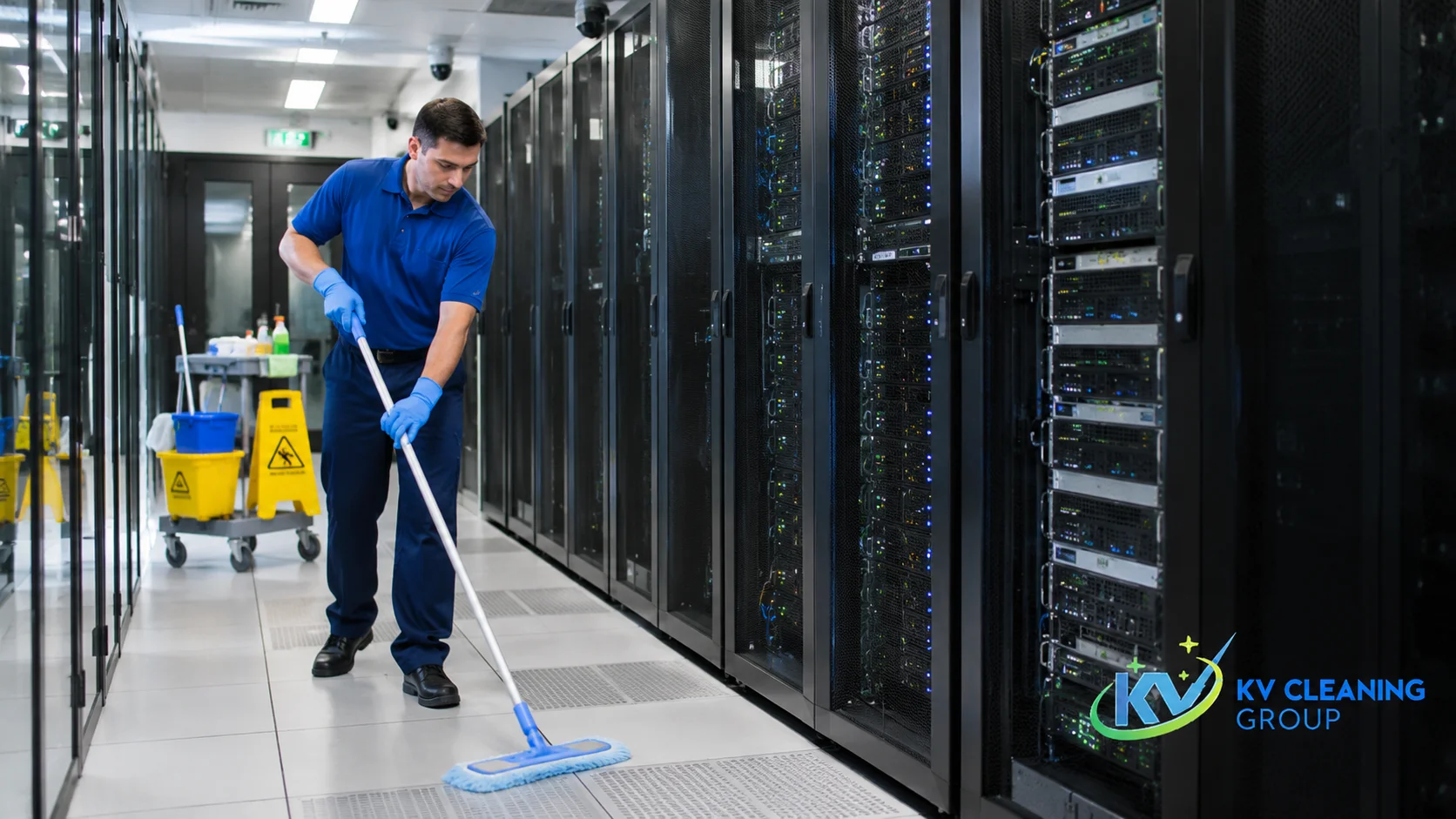
Cleaning boundaries, escort rules and approved access windows are discussed before work starts.
Live equipment, cabling, controls and restricted components remain outside the scope unless separately authorised.
Methods and products are selected only after the surfaces, equipment proximity and site procedures are understood.
The agreed task list, service frequency and site contact provide a shared reference for the work.
Not every technical room has the same layout. Some sites have a single communications cupboard; others include separate server rooms, equipment halls, access vestibules and raised-floor sections. The following areas can be reviewed during the site assessment, subject to access and approval.
Accessible floor surfaces can be checked for tracked-in dust and loose debris. The cleaning method must suit the floor finish and remain within the approved moisture limits.
Accessible external cabinet surfaces and surrounding areas may be included when the facility contact confirms the boundaries. Internal equipment and live connections are not routine cleaning surfaces.
Raised floor tiles and the surrounding walking surface need a planned method. Tile lifting, if required, must be authorised and coordinated with the facility or IT team.
Where a raised floor void is part of the approved scope, access, tile handling, cable locations and airflow considerations must be reviewed before any work is undertaken.
Smaller comms rooms and network cupboards can be considered as separate zones, with the equipment boundary and permitted cleaning surfaces identified in advance.
Doorways, transition areas and approved entry mats can collect dust brought in by footwear, cartons and equipment deliveries. These areas can be listed as routine tasks.
Control rooms, staging areas and nearby offices may have different cleaning requirements from the data hall itself. Separating these zones helps prevent the wrong method being used.
Door glass, handles and other approved fixtures can be cleaned with surface-compatible products, keeping spray and moisture away from equipment and air intakes.
A data centre cleaning plan needs clear boundaries. A task suitable for a corridor may not be suitable beside a live rack. KV Cleaning Group can discuss the areas you want considered and identify which work needs facility approval, specialist equipment or a separate qualified provider. For broader workplace requirements, you can also review our commercial cleaning services in Sydney.
Remove loose soil from approved floor areas using a method and equipment appropriate to the floor finish and the site's dust-control requirements.
Clean approved external surfaces, ledges and cabinet surrounds without opening equipment, disturbing connections or moving IT assets.
Maintain approved doorways, access mats and adjacent circulation areas where dust can be carried into the technical space.
Discuss deeper cleaning for selected areas after construction, installation or maintenance work, with access and equipment boundaries agreed first.
A dedicated data centre is not the only place where sensitive IT equipment is kept. Many businesses have a server room behind a secure office door, a network cabinet in a communications room or a small equipment space supporting daily operations. Each setting needs a scope that reflects its actual use.
Enquiries may relate to colocation facilities, enterprise data halls, corporate server rooms, communications rooms, network rooms, disaster recovery spaces, IT support areas or technical rooms within commercial buildings. The work that can be undertaken depends on the site's procedures, access approval and the team's confirmed capability.
Where the room sits inside a larger workplace, the surrounding premises may need a separate routine. Our office cleaning service can be considered for the non-technical areas, while the server room remains a separately scoped space.
Discuss Your Facility RequirementsThe most useful first step is a conversation with the person responsible for the room. It helps identify the access process, sensitive areas, approved cleaning methods and what the facility expects to be left untouched.
Confirm the room type, approximate floor area, floor construction, equipment layout, operating status and the areas being considered.
Identify sign-in rules, escort requirements, security restrictions, change windows, emergency contacts and equipment that must not be touched.
Document permitted surfaces, tools, products, moisture limits, exclusions, waste handling and any approval needed before work begins.
Arrange the work around the facility's access window and operational requirements. Do not assume after-hours or live-site access until confirmed.
Use the agreed checklist to record completed areas, any access limitations and items that need the facility contact's attention.
Revisit the scope when equipment layouts, room use, building works or access requirements change.
Floor area is useful when requesting a quote, but it does not tell the whole story. Rack density, raised flooring, cable routes, access restrictions, room shape and the number of separate zones can change the work considerably.
An illustrative size for a compact communications room or small server space.
An illustrative range for a room with multiple racks or clearly separated equipment zones.
An illustrative range where staged access and a more detailed site plan may be needed.
An illustrative scale for a larger data hall or facility with several connected technical areas.
These floor-area examples are planning illustrations only. They are not measured KV Cleaning projects, industry averages, fixed service limits or cleaning-time estimates. A site assessment is needed to understand the actual workload.
There is no single cleaning frequency that suits every data centre. The schedule should reflect the facility's own contamination-control plan, occupancy, maintenance activity, dust sources, equipment layout and operator requirements. A facility manager or IT contact should approve the final interval.
Regular attention to agreed floor areas, entry zones and approved external surfaces. The interval may be weekly, fortnightly or another site-approved pattern.
Less frequent work for selected surfaces or zones that need additional attention, scheduled around operational and access requirements.
Construction dust and packaging debris require a separate plan. Cleaning should take place only after the responsible project and facility teams approve the work area and sequence.
Where contractors have worked in or around a technical room, agree whether additional cleaning is needed and which party is responsible for each area.
A product that works on an office floor may not be suitable near IT equipment. The surface, residue, moisture level, electrical risk and facility procedure all matter. Product names should never be chosen simply because they are common in commercial cleaning.
May be considered for compatible hard floors outside equipment boundaries, using the label dilution and controlled application method.
Use only where the facility has approved the product for the specific surface and the cleaning method is within the team's training and capability.
Can be used on approved doors or partitions with a cloth-applied method that prevents mist or liquid from reaching equipment.
Vacuum selection and filtration must match the facility's dust-control and electrostatic requirements. Do not claim HEPA or ESD capability unless the actual equipment is verified.
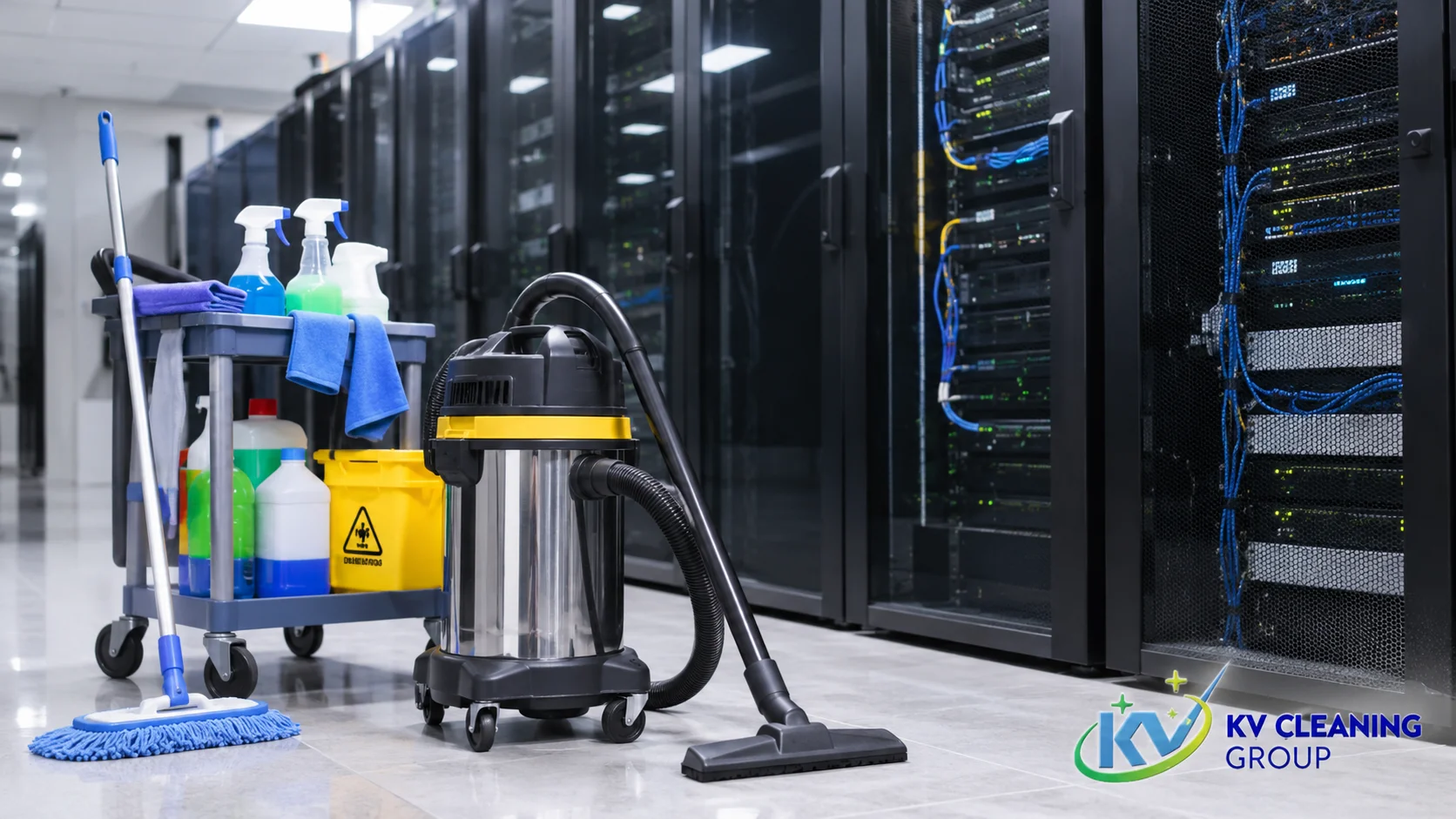
Never spray liquid directly towards racks, servers, cable connections, vents or electrical equipment. Do not wet-mop near live equipment. Use a lightly dampened cloth only on surfaces specifically approved for that method. Follow the product label, the current Safety Data Sheet (SDS), site procedures and the facility manager's instructions. Never mix cleaning chemicals. For more information about airborne particle classification, consult the official ISO 14644-1 standard overview; it describes cleanroom air-particle classification and does not by itself certify a cleaning contractor or a data centre.
Technical spaces require careful coordination between the cleaning provider and the people responsible for the infrastructure. KV Cleaning Group's wider commercial cleaning experience includes offices, warehouses and other business premises. For a data centre or server room enquiry, the important step is to confirm the exact work, the team's relevant capability and the documents required by the site before accepting the job.
KV Cleaning Group publishes company-wide figures of 22+ years of experience, 525+ commercial cleaning projects, 126+ businesses served annually, 1.2M+ square metres cleaned and 43+ trained professionals. These are company-reported figures, not data-centre-specific project counts or independently audited technical credentials. You can read more about KV Cleaning Group and its background when evaluating the provider.
For facilities with adjacent operational areas, the scope may also need to coordinate with facility cleaning requirements, industrial cleaning requirements or warehouse cleaning arrangements. Each area should have its own method and access rules.
Use the following points to make the scope clear for both the facility contact and the cleaning team.
Mark the rooms, zones and surfaces included in the task. Identify areas that are restricted or excluded.
Confirm that cleaners will not unplug, open, move or adjust IT equipment, cables, sensors or controls.
Agree sign-in, escort, identification, key handling, alarm and emergency-contact procedures.
Record product names, SDS availability, dilution, application method and any prohibited chemicals.
Agree how completed tasks, inaccessible areas, incidents and follow-up actions will be recorded.
Identify who can approve additional tasks, changes to the method or access outside the agreed window.
Answers to common questions from IT managers, facility teams and businesses considering server room cleaning in Sydney.
The scope depends on the facility and its approved procedures. It may include accessible floors, entry areas, approved external surfaces, selected support spaces and other agreed zones. Raised-floor voids, rack interiors, cabling and live equipment require separate authorisation and appropriately qualified personnel. The written scope should state exactly what is included and excluded.
KV Cleaning Group can discuss enquiries for server rooms and communications rooms in Sydney. Share the suburb, approximate room size, number of zones, access conditions and the areas you want considered. The team must confirm service suitability, capability and availability before a cleaning date is agreed.
That depends on the facility's operating rules and the approved task. Any work in an operational environment must be planned with the facility manager or IT team, including access windows, exclusion zones, equipment boundaries and stop-work instructions. Do not assume that all tasks can be completed while systems are live.
Raised floor tile lifting should never be treated as a routine floor-cleaning task. It requires approval from the responsible facility team, a clear method, suitable tools and an understanding of what is beneath the floor. If the team is not authorised and equipped for this work, it should be referred to an appropriately qualified specialist.
There is no universal liquid cleaner for server rooms. The facility's approved product list, surface manufacturer's instructions and product SDS should guide selection. A compatible floor cleaner may be used on approved floors outside equipment boundaries; approved glass cleaner may be suitable for doors or partitions. Liquids must not be sprayed onto or near live equipment, vents or connections.
Equipment requirements should be confirmed before the work is accepted. If the site requires ESD-safe or anti-static tools, the exact equipment and its suitability must be verified and documented. Do not rely on a general-purpose vacuum or cloth in a controlled technical environment.
Frequency depends on the facility's contamination-control plan, room use, dust sources, foot traffic, maintenance activity and equipment layout. Some sites may require regular attention to entry and floor areas, with separate periodic tasks for other zones. The facility operator should approve the interval rather than relying on a universal schedule.
A small communications room can be assessed as a separate area within a wider office cleaning enquiry. It should have its own task list, equipment boundaries and access instructions. The normal office cleaning checklist should not automatically be applied inside a technical room.
Provide the site suburb, approximate floor area, room type, number of rooms or zones, floor construction, preferred service window, operating status, access rules, requested tasks and any required documents. A floor plan or site checklist can help the facility contact explain restricted areas and equipment boundaries.
Post-construction or post-installation cleaning needs a separate assessment because building dust, packaging and installation debris may require a controlled sequence. The builder, facility manager and IT team should confirm when the area is released, what equipment is already installed and which cleaning methods are permitted before work begins.
Tell us where the facility is, its approximate size and which areas need attention. We can discuss the site requirements and confirm whether the requested work is suitable before any service is scheduled.
Call KV Cleaning Group to discuss the room, access arrangements and proposed cleaning scope.
KV Cleaning Group provides reliable commercial cleaning services for offices, warehouses, retail spaces, medical facilities and other workplaces across Sydney.
Our team works around your site requirements, cleaning schedule and access needs to help maintain a clean, safe and professional workplace. Contact us to discuss the right cleaning solution for your business.