Customer Banking Halls
Maintain accessible floor areas, entry glass, waiting zones and customer-facing surfaces so the branch remains presentable during service hours.

A bank branch is a public-facing workplace with a different rhythm from a standard office. Customers move through the lobby, staff work behind counters, ATMs may remain accessible after closing, and some rooms have strict access conditions. KV Cleaning Group provides commercial cleaning support for Sydney premises. You can also review the company’s full range of cleaning services, with the proposed bank cleaning scope discussed around the layout, authorised areas and operating hours of each site.
From a compact suburban branch to a larger financial office, the first step is to identify which floors, counters, customer spaces, amenities and staff areas are included. Restricted cash-handling rooms, security systems and sensitive devices are not treated as ordinary cleaning surfaces.
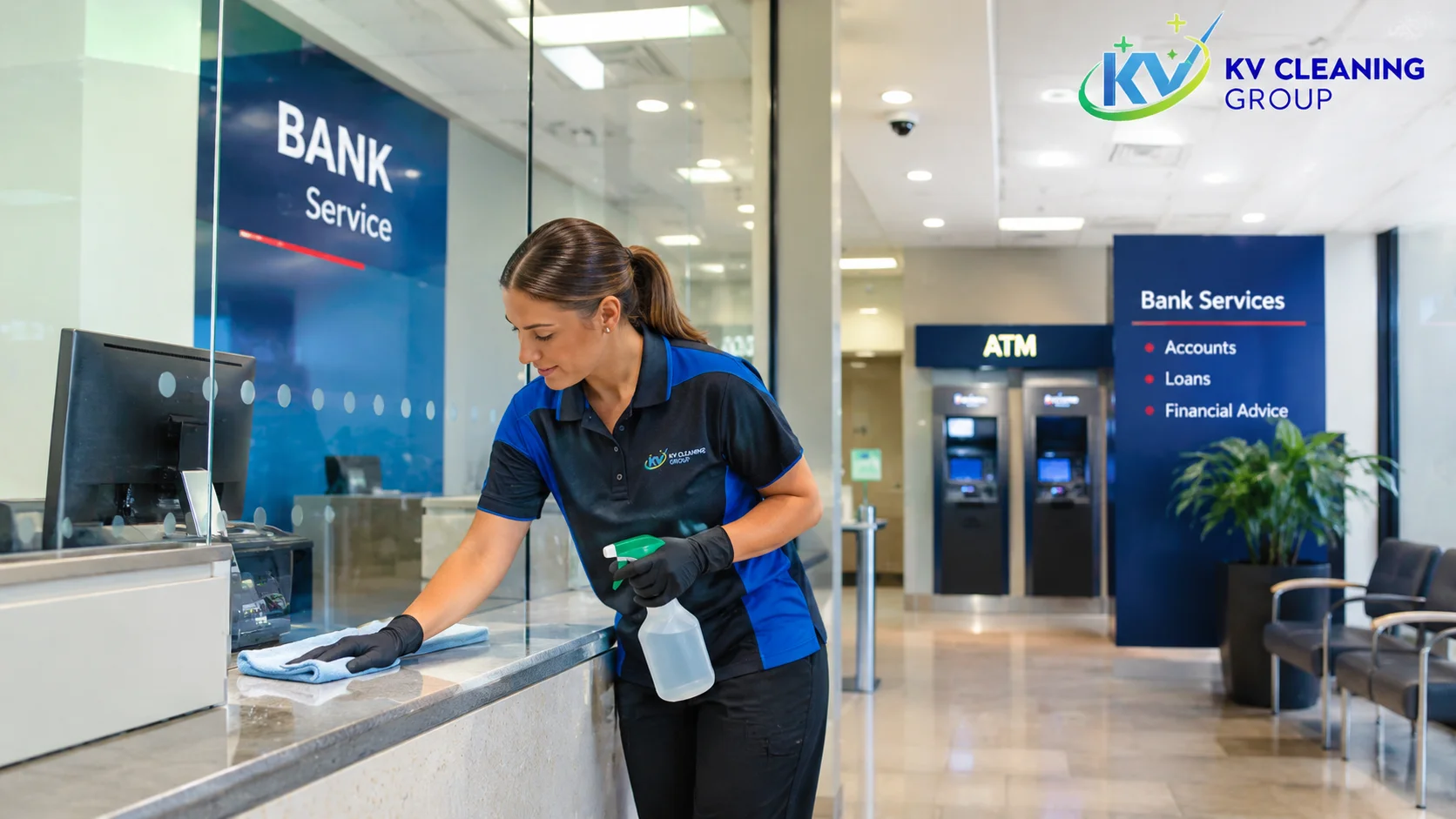
Identify public, staff-only and restricted spaces before tasks are assigned.
Discuss cleaning windows that fit branch opening times and building access rules.
Match cloths, floor methods and cleaning products to the surfaces being maintained.
Set out included tasks, exclusions, frequencies and the person who approves changes.
Not every room in a financial facility can be approached in the same way. A customer lobby, staff kitchenette and secure records room have different access and handling requirements. The areas below can be considered for a cleaning plan where the bank authorises access.
Maintain accessible floor areas, entry glass, waiting zones and customer-facing surfaces so the branch remains presentable during service hours.
Clean approved counter surfaces and accessible desk areas using cloths and products compatible with the finish and the bank's instructions.
Attend to nearby floors, glass and approved exterior touchpoints. ATM internals, card readers and payment components remain outside routine cleaning.
Dust reachable, cleared surfaces and clean accessible floors in offices, meeting rooms and administrative areas without moving confidential papers or personal items.
Prepare tables, chairs, glass partitions and floors for scheduled meetings, following instructions about documents, equipment and room access.
Clean benches, sinks, appliance exteriors, tables and floors. Food, personal belongings and stored items are left undisturbed unless agreed otherwise.
Clean toilets, basins, mirrors, dispensers and floors using designated cloths and washroom products to avoid cross-use with other areas.
Remove tracked-in soil, clean reachable touchpoints and maintain clear walkways around customer entrances and shared building access points.
Where access is approved, maintain the accessible floor, door glass and surrounding surfaces without interrupting customer use or interfering with devices.
A useful bank cleaning brief is specific. It records the rooms that can be entered, the surfaces that need attention, the approved products and the process for reporting an area that could not be completed. For wider property requirements, see our facility cleaning services.
Discuss the suburb, floor area, levels, customer flow, staff facilities, floor finishes and any areas that must remain locked or untouched.
Confirm authorised entry times, sign-in arrangements, keys or access cards, alarm instructions, product restrictions and the site contact for questions.
Document visit frequency, priority tasks and how incomplete work or maintenance concerns will be reported and reviewed with the authorised contact.
The floor area gives a starting point, but it does not tell the whole story. A 150 m² branch with several customer touchpoints, two washrooms and an ATM vestibule may require a different task allocation from a 150 m² back-office suite with fewer shared surfaces.
For an initial discussion, a small branch might have around 100–250 m² of cleanable space, a medium branch around 250–600 m², and a larger branch or combined office area around 600–1,200 m² or more. These are illustrative planning bands only—not measured KV Cleaning Group projects, industry averages, fixed service limits or a promise of cleaning time.
For a useful quote, separate the total building area from the actual cleanable area. Note the number of levels, public and staff zones, floor types, washrooms, ATM access areas and any rooms excluded from the work. A site review or floor plan can help clarify the scope.
Discuss Your Branch Floor AreaKV Cleaning Group reports more than two decades of commercial cleaning experience and work across a range of business premises. The figures below are company-reported business information, not bank-specific project results or independently audited performance measures. Read more about KV Cleaning Group and its background.
Company-reported experience in commercial cleaning and workplace maintenance.
A reported project count across the company's broader cleaning work, not bank contracts alone.
Reported team size across the business; the team assigned to a site depends on its agreed scope.
A company-wide figure describing broader cleaning activity, not the area of bank premises.
A reported annual business figure across the company's wider client base.
Bank-specific access, clearances, insurance evidence and product approvals should be checked and agreed before service begins.
A bank contains several different materials: sealed floors, stone or tile, glass partitions, laminates, metal fittings, screens and electronic terminals. One chemical should not be used across all of them. The bank's approved chemical list, product label, Safety Data Sheet (SDS) and manufacturer instructions should guide selection.
A pH-neutral or surface-compatible cleaner may suit sealed vinyl, tile or other approved hard floors. Follow the label dilution, avoid excess water and use only on compatible finishes.
Use a disinfectant only on surfaces and touchpoints for which it is approved. Observe the label contact time and never assume a product is suitable for screens, coated counters or payment terminals.
Choose a compatible product for doors, partitions and metal finishes. Apply to a cloth where appropriate rather than spraying near computers, card readers or other electronic equipment.
Use clean, colour-coded cloths for separate zones and a suitable vacuum for carpet and entry matting. Equipment must be maintained and used without blocking customer routes or disturbing sensitive devices.
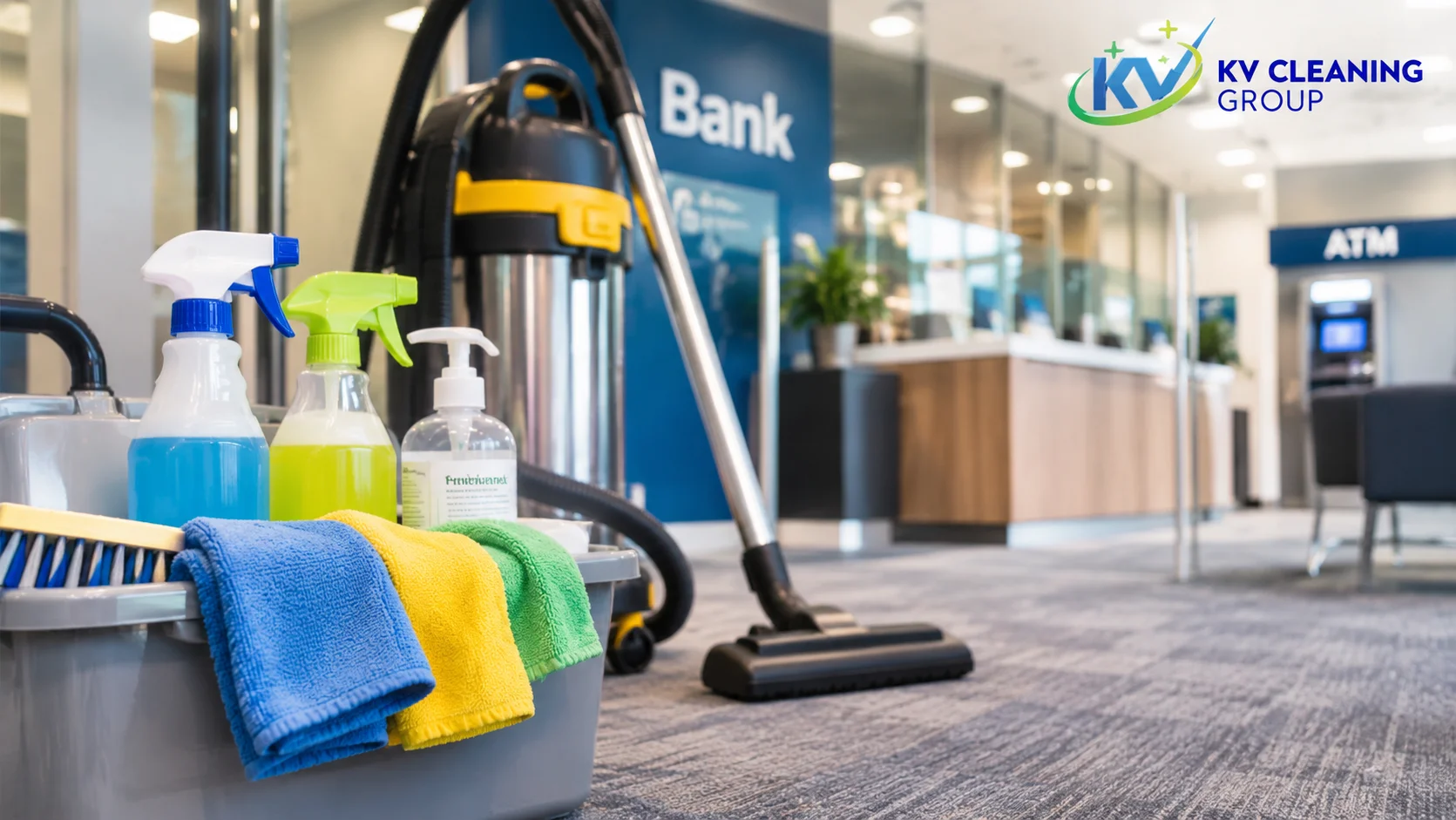
Never mix chemicals, decant products into unlabelled containers or use a spray around exposed electronics. Keep current SDS information available and follow the site's chemical approval and storage procedures. SafeWork NSW guidance on hazardous chemicals explains why workplace chemical risks need proper controls.
The right frequency depends on branch foot traffic, operating hours, customer use, building rules and the standard required by the bank. A daily schedule is not automatically necessary for every room, and periodic work should be listed separately from routine tasks.
Tasks agreed for each visit to maintain customer-facing and staff areas.
Additional tasks scheduled separately to address areas that need more detailed maintenance.
A cleaning plan should make clear what cleaners may enter, touch, move or report. The bank or building manager remains responsible for authorising access and explaining its security procedures. KV Cleaning Group should only undertake tasks within the agreed scope and confirmed capability.
Confirm sign-in, visitor identification, keys, access cards, escort requirements and the authorised site contact before the first visit.
Mark cash handling, records, server, security and other restricted areas as excluded unless written authorisation and a suitable procedure are provided.
Agree how to report locked rooms, spills, damage, maintenance concerns or tasks that could not be completed during the scheduled visit.
Answers to common questions from branch managers, property teams and financial office coordinators planning a cleaning service.
Depending on the agreed scope, routine work may include customer lobby floors, accessible counters, meeting rooms, staff offices, kitchens, washrooms, entry glass, bins and approved high-touch surfaces. ATM surrounds can be included where authorised. Cash handling rooms, secure records areas and internal electronic equipment are not assumed to be part of routine cleaning.
Cleaning windows can be discussed around branch trading hours and building access. Before-hours, after-hours or weekend arrangements depend on the site's approval, staff availability, alarm procedures and any required supervision. The final timing should be confirmed with the authorised bank contact.
ATM lobby floors, surrounding glass and approved exterior surfaces may be included in the cleaning brief. The bank must provide instructions for the specific ATM model and approve the method. Cleaners should not open machines, handle internal components or apply liquid directly to keypads, screens or card readers.
Frequency depends on customer numbers, branch size, floor type, washroom use and the bank's presentation requirements. High-use customer areas may need more frequent attention than low-occupancy offices. A site assessment helps separate daily tasks from weekly or periodic work.
Share the suburb, approximate cleanable floor area, number of levels, branch layout, floor finishes, number of washrooms, ATM lobby details, preferred cleaning times and required frequency. Also identify restricted spaces, site induction requirements and any approved-product list.
Multiple locations can be discussed as a portfolio. Each branch should still have its own site notes covering access, floor area, included rooms, local building rules and task frequency. A common checklist or reporting format can make oversight easier without assuming every branch needs identical work.
There is no single chemical suitable for every surface in a bank. Select products according to the surface manufacturer's instructions, the bank's approved chemical list, product label and SDS. Disinfectants should only be used on compatible surfaces and for their labelled contact time. Never mix chemicals or spray near electronic equipment.
These areas must be identified as restricted during the initial discussion. They should only be considered if the bank explicitly authorises access, confirms its procedures and the required personnel and capability are agreed. Otherwise, they remain outside the cleaning scope.
Staff amenities, kitchens, washrooms, meeting rooms and agreed office areas can be considered as part of a wider branch cleaning schedule. The task list should identify which consumables, waste streams and restocking duties are included rather than assuming they are automatically covered.
Enquiries for financial offices and administrative premises can be discussed. The cleaning plan should reflect the building layout, employee occupancy, shared facilities, access restrictions and any equipment or documents that must remain undisturbed.
Tell us which areas need attention, the approximate floor area, your preferred cleaning window and any access or product restrictions. KV Cleaning Group can review the details with you and discuss a suitable next step. For other workplace requirements, you can also explore our office cleaning services or wider industrial cleaning services.
Call our team or send an enquiry with your site details.
KV Cleaning Group provides reliable commercial cleaning services for offices, warehouses, retail spaces, medical facilities and other workplaces across Sydney.
Our team works around your site requirements, cleaning schedule and access needs to help maintain a clean, safe and professional workplace. Contact us to discuss the right cleaning solution for your business.