

Carpet Cleaning Sydney
Carpeted areas in commercial buildings collect dry soil, tracked-in grit, drink spills and traffic marks at different rates. The right cleaning plan depends on the carpet construction, how the area is used, its condition and when the space needs to return to service.
KV Cleaning provides carpet cleaning services in Sydney for offices, hotels, retail premises, schools, strata properties, healthcare environments and other suitable business settings. Arrange a one-off deep clean, targeted stain assessment or recurring maintenance plan according to the carpeted area and site schedule.
Before a method is selected, we consider the fibre and construction, total carpeted area, visible soil, previous stain treatment, furniture, access and the time available before the space is used again. These details help set the scope and avoid applying the same method to every carpet.
The aim is practical: select a method that suits the carpet, manage moisture, use cleaning products according to their directions and explain which marks may improve and which may be permanent damage.
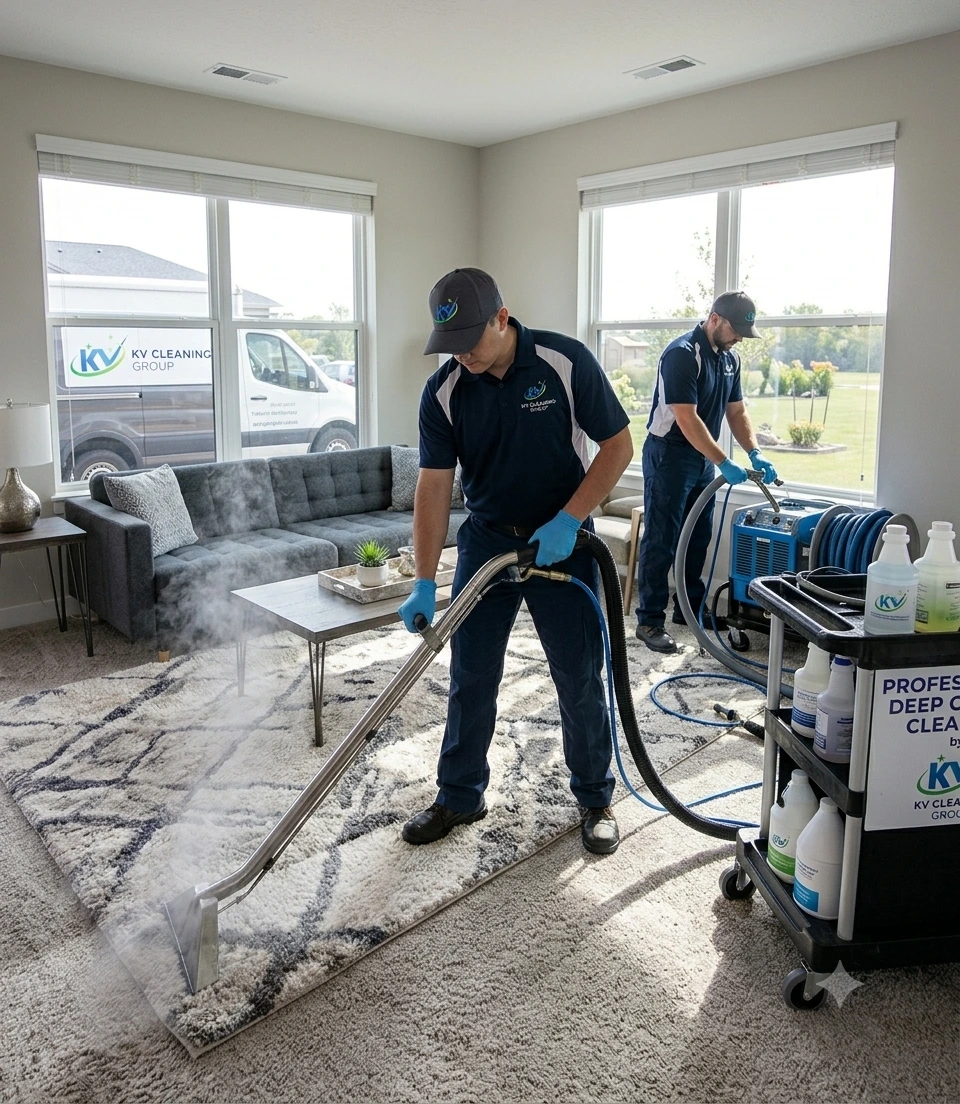
Carpet Cleaning Services Sydney for Business Premises
Office reception, hotel corridors, retail areas, school facilities and strata foyers collect soil in different ways. The scope should reflect the carpet condition, level of use, access requirements and the time available before each area returns to service.
Reception & Lobby Carpet Cleaning
Entrances, lobbies and reception areas often collect grit from outside and can show traffic marks sooner than quieter rooms.
Office Carpet Cleaning
Reception areas, workspaces, meeting rooms and corridors can be cleaned around staff movement, furniture and normal operating hours.
Hotel Carpet Cleaning
Guest corridors and common areas can require careful scheduling because presentation, traffic and access change throughout the day.
Retail Carpet Cleaning
Customer-facing carpet can collect outdoor grit and spills quickly, especially around entrances, counters and high-footfall areas.
School & Education Carpet
Carpeted administration areas, rooms and circulation spaces can be planned around timetables, access and the site's cleaning requirements.
Strata & Shared Areas
Foyers, corridors, lifts and shared carpeted areas often need attention where residents and visitors create repeated daily traffic.
Healthcare Areas
Cleaning plans can be discussed for suitable carpeted areas in healthcare and allied health environments, subject to site requirements.
Commercial Buildings
Multi-area workplaces can combine routine carpet care with broader cleaning requirements while keeping the scope clear.
What a Professional Carpet Cleaning Visit Should Cover
Professional carpet cleaning should be more than running equipment over every room at the same speed. A useful service starts by understanding the material and the problem, then choosing a process that makes sense for that particular carpet.
This matters when a property contains different carpet types, heavily used entrances, delicate areas, fixed furniture or rooms that need to return to normal use within a particular time window.
Assess the Carpet First
Check fibre, construction, condition, soil, stains and access before deciding on the cleaning method.
Remove Embedded Soil
Use appropriate vacuuming, pre-treatment and cleaning steps to address soil beyond the loose surface layer.
Respond to Spills
Target suitable stains according to the substance, age, fibre and previous treatment rather than using one product for everything.
Focus on Traffic Areas
Entrances, corridors and reception zones can need more attention than lightly used rooms.
How Carpeted Area Changes the Cleaning Plan
Square metres are useful when discussing a job, but they do not tell the whole story. Room layout, furniture, traffic, carpet condition, access and the chosen method can change the workload.
Up to 100 m²
Often suitable for a focused clean of a compact office, reception or a small group of carpeted rooms.
100–500 m²
May include several rooms, corridors or shared zones where preparation, furniture and access need to be considered together.
500–1,000 m²
Larger workplaces may benefit from cleaning zones and sequencing so busy areas, quieter areas and access routes are handled logically.
1,000+ m²
Large commercial properties may require staged work, coordinated access, equipment planning and a clearer return-to-use plan.
These size bands are planning examples, not fixed pricing or staffing promises. A 200 m² office with heavy traffic and fixed furniture can require a different approach from an open 500 m² floor with easy access. The actual scope should be based on the property.
Choosing the Right Carpet Cleaning Method
There is no single method that should be used on every carpet. The selected process should suit the fibre, construction, condition, soil level and time available before the area is used again.
Hot-Water Extraction
Often used for deeper cleaning where the carpet is suitable for controlled moisture and extraction. Drying conditions need to be planned.
Low-Moisture Cleaning
Can be useful when a property needs a lower-moisture approach and quicker return-to-use conditions are important.
Encapsulation Cleaning
A maintenance-oriented option for suitable commercial carpets where controlled cleaning and routine soil removal are required.
Targeted Spot Treatment
Specific products and techniques can be considered for individual stains after identifying the carpet and likely cause.
Carpet Steam Cleaning Sydney: “steam cleaning” is commonly used by customers to describe hot-water extraction. The method still needs to suit the carpet, and the building needs enough time and ventilation for the expected moisture and drying requirements.
What Liquids Can Carpet Cleaners Use?
Cleaning chemistry should match the carpet and the task. Stronger does not automatically mean better. Product choice, dilution, contact time, extraction and safe handling all matter.
Pre-Treatment Solutions
Used where appropriate to loosen soil before the main cleaning process. The product should be suitable for the carpet.
Extraction Detergents
Cleaning solutions selected for compatible extraction equipment, carpet materials and the level of soil being treated.
Spotting Products
Targeted products may be used for particular stains after considering the substance, age and likely reaction of the fibre.
Fibre-Suitable Chemistry
Carpet material and manufacturer guidance should influence product selection rather than applying the same chemical everywhere.
Moisture Control
Liquid use should be controlled so the carpet is not unnecessarily saturated and the expected drying conditions remain practical.
No Casual Chemical Mixing
Different cleaning chemicals should not be mixed unless the manufacturer specifically permits it. Labels and safety information matter.
For workplace chemical information, see Safe Work Australia's Safety Data Sheet guidance. Customers with specific product or building requirements should raise them before the service begins.
Deep Carpet Cleaning Is Not the Same as Promising Every Stain Will Disappear
Stain treatment works best when the cleaner knows what caused the mark and what has already been applied to it. Coffee, food, grease, coloured drinks, ink and tracked-in soil can behave differently, so one general product is not suitable for every mark.
Age and previous treatment also matter. A fresh spill may be easier to address than a mark that has been repeatedly treated. A stain may be harder to improve if it has been heat-set, bleached or chemically altered, and previous DIY products can change how the carpet responds.
Odour needs similar care. Cleaning the visible carpet may not solve a recurring smell if the source sits beneath the pile, in the backing or outside the carpet itself. Where the source can be identified and the affected area is suitable for treatment, the scope can be adjusted accordingly.
Cleaning May Improve
- General embedded soil
- Many food and drink marks
- Traffic-related darkening
- Some odour problems where the source can be treated
- Overall appearance after accumulated soil is removed
Cleaning Cannot Reverse
- Permanent dye loss or colour change
- Burns and severe fibre damage
- Chemical damage to the material
- Advanced wear and crushed fibres
- Tears, delamination or damaged backing
Carpet Care for Busy Offices, Retail Sites and Commercial Buildings
Commercial carpet is exposed to repeated foot traffic, furniture movement, tracked-in grit and spills. The useful question is not simply “How often should it be cleaned?” but which areas need the most attention, which method fits the carpet and when the work can be completed without disrupting the site.
For broader workplace requirements, see our commercial cleaning service. For office-specific routines, see our office cleaning service.
Entrances & Reception
These areas can collect outdoor soil faster than quieter rooms and may need closer monitoring.
Corridors & Walkways
Repeated movement can create visible traffic lanes and concentrated wear.
Meeting & Shared Areas
Usage can change from day to day, so cleaning frequency can be reviewed as occupancy changes.
After-Hours Planning
Where access permits, cleaning can be discussed around quieter periods and the property's operating schedule. This is also useful when planning commercial carpet cleaning without disrupting business operations.
How Often Should Carpet Be Professionally Cleaned?
There is no universal timetable. A sensible schedule follows traffic, soil entering the property, carpet type, routine vacuuming, presentation requirements and the consequences of allowing build-up to continue.
Bedrooms & Quiet Rooms
Less-used carpet may need periodic professional attention when routine care and prompt spill response are keeping it in reasonable condition.
General Office Areas
Workspaces and circulation areas can benefit from a recurring maintenance cycle when everyday soil is building faster than routine vacuuming can manage.
Entries, Lobbies & Corridors
Check these zones more often because outdoor grit and repeated footfall can change their appearance quickly. Increase professional cleaning frequency only where inspections show it is needed.
Hotels & Retail
Busy customer environments may need interim care plus periodic deeper cleaning planned around operating conditions.
What Helps Carpet Cleaners Prepare the Right Job?
A little information before the appointment can make the service more efficient and the quotation more meaningful.
Approximate Carpet Area
Share the approximate square metres and identify the rooms, corridors, stairs or other carpeted zones included. If exact measurements are unavailable, a floor plan or photos can help clarify the areas to be assessed.
Furniture & Access
Explain fixed furniture, lifts, stairs, parking or other access conditions that could affect equipment movement.
Known Stains
Point out spills, old marks and any previous products used. This helps set realistic treatment expectations.
Preferred Service Window
Tell the team when the area must be ready again so the method and scheduling discussion can account for access and drying.
A Clear Carpet Cleaning Process From Enquiry to Completion
The exact work varies by property, but a clear sequence helps customers understand what is being planned. Agreeing the areas, preparation, selected method and drying expectations before the visit reduces uncertainty on the day.
Property Details
Understand location, carpeted area, access, traffic and the main cleaning requirement.
Carpet Assessment
Consider fibre, construction, condition, soil, stains and suitable cleaning options.
Preparation
Plan access, furniture requirements and any necessary pre-treatment before the main clean.
Selected Method
Use the agreed cleaning approach with appropriate equipment, products and moisture control.
Stain & Spot Work
Target suitable stains while recognising that some permanent damage cannot be reversed by cleaning.
Drying & Final Check
Review the cleaned area, discuss drying conditions and explain any points the customer should know.
Why Regular Carpet Care Can Be More Useful Than Waiting for a Problem
Professional cleaning complements routine vacuuming and prompt spill response; it does not replace either. It is most useful when soil, traffic marks or recurring stains have built up beyond what routine maintenance can reasonably address. The timing should follow the carpet’s condition and the building’s access requirements rather than a universal calendar rule.
Maintain Presentation
Cleaner carpet can help reception areas, workspaces and customer-facing rooms look more cared for, while regular professional care can support longer carpet service life.
Address Embedded Soil
Routine vacuuming and periodic professional methods serve different purposes in a carpet maintenance plan. Learn how regular carpet cleaning can support indoor air quality.
Respond to Spills
Prompt attention can be more useful than leaving a spill to dry and become harder to treat later.
Watch Traffic Zones
Entrances and corridors can be monitored separately because they often collect soil faster than quiet rooms.
Make Maintenance Predictable
A planned cycle can help property managers budget time and access instead of waiting until carpet appearance has deteriorated.
Spot Problems Earlier
Regular attention can make it easier to identify damaged backing, permanent stains or worn areas that need a different solution.
Carpet Cleaning Can Sit Within a Wider Property Cleaning Plan
Carpet cleaning can be scheduled on its own or coordinated with other agreed workplace cleaning. The links below lead to distinct services; use them when the property requires more than carpet care.
Medical Facilities
For broader clinical and healthcare cleaning requirements, see our medical centre cleaning service.
Strata Properties
Shared foyers and common areas can be managed through our strata cleaning service.
Warehouse Sites
For operational cleaning beyond carpet, see our warehouse cleaning service.
Large Facilities
For broader building requirements, our facility cleaning service covers multiple shared and high-use areas.
What to Ask a Carpet Cleaning Provider Before Booking
Comparing only the headline price can hide differences in scope. Ask each provider to identify the included carpeted areas, stain treatment, furniture and access assumptions, chosen method, drying guidance and any additional charges before approving a quote.
How Much Carpet Is Included?
Confirm the approximate carpeted square metres and the rooms, corridors, stairs or zones included.
What Is Included?
Ask whether preparation, main cleaning, stain treatment, furniture access and final checks are part of the quoted scope.
Which Method and Products?
Ask why the proposed method suits the carpet and which pre-treatment or spot products may be used.
What Drying Conditions Apply?
Confirm expected drying conditions, access restrictions and when normal use can reasonably resume.
Carpet Cleaning Cost Sydney Customers Should Compare by Scope
A useful quote should reflect the actual work rather than a headline rate alone. Area is important, but carpet condition, furniture, staining, access, method and the required service window can all change the workload.
What Can Change the Quote?
- Total carpeted square metres
- Number and shape of rooms or zones
- Soil and traffic level
- Number and type of stains
- Furniture and equipment access
- Carpet material and selected method
- One-off or recurring service
- Preferred service window
- Building operating requirements
Two 500 m² properties can have very different workloads. One may be open and lightly furnished with easy access; another may contain many rooms, fixed furniture, heavy traffic and restricted entry. A property-specific quotation is therefore more useful than assuming every square metre has the same workload.
Carpet Cleaning Sydney Across Greater Sydney
KV Cleaning's service-area information covers a broad range of Sydney districts. Availability can depend on the suburb, property type, access and work required.
Sydney CBD
City workplaces, offices, hotels, retail premises and shared buildings.
North Sydney & North Shore
Office and commercial properties across major northern business areas.
Western Sydney
Commercial workplaces, facilities, warehouses and business properties.
Eastern Suburbs
Offices, strata properties, retail sites and other local premises.
South & South-West
Commercial and operational properties requiring planned carpet care.
Greater Sydney
Other locations can be discussed with the team based on current service availability.
Carpet Cleaning Sydney FAQs
Straightforward answers to common questions about methods, stains, liquids, drying, pricing and service coverage.
What do professional carpet cleaners in Sydney do? +
A professional carpet cleaning service assesses the carpet, traffic, soiling, stains and site conditions before choosing a suitable method. The scope may include preparation, pre-treatment, deep cleaning, stain work, extraction and a final check.
Is carpet steam cleaning the same as hot-water extraction? +
The terms are often used interchangeably in carpet cleaning. Hot-water extraction applies cleaning solution and heated water before recovering the loosened soil and moisture with extraction equipment.
Is hot-water extraction suitable for every carpet? +
No. Fibre type, carpet construction, condition, manufacturer care guidance and moisture tolerance should be considered before choosing a wet-cleaning method. Some carpets are better suited to lower-moisture or controlled treatment.
What cleaning liquids do carpet cleaners use? +
Depending on the carpet and soil, a service may use a pre-treatment solution, extraction detergent or targeted spot treatment. Products should be selected for the material and used at the manufacturer's recommended dilution and handling requirements.
Can professional carpet cleaning remove every stain? +
No. Cleaning can improve many stains and areas of soiling, but permanent dye loss, burns, fibre damage, chemical alteration, severe wear and damaged backing may not be reversible.
How much carpet can be cleaned in one visit? +
There is no useful single maximum area. Workload depends on carpeted square metres, room layout, furniture, condition, traffic, access, equipment and the method selected. Larger properties can be planned in stages where practical.
How long does carpet take to dry after cleaning? +
Drying varies with the carpet, method, moisture level, extraction efficiency, airflow, temperature and humidity. The expected drying conditions should be discussed before service so the property can plan re-entry.
How often should carpets be professionally cleaned? +
Frequency depends on traffic, carpet type, soil accumulation, property use and the presentation standard required. Busy entrances and corridors generally need closer monitoring than lightly used rooms.
How much does carpet cleaning cost in Sydney? +
Pricing depends on carpeted area, condition, stain levels, furniture, access, cleaning method, service timing and whether the work is one-off or recurring. A property-specific quotation is more useful than a generic rate.
Do you provide carpet cleaning across Sydney? +
KV Cleaning provides carpet cleaning for offices, hotels, retail premises, schools, strata properties, healthcare facilities and other suitable business environments across Sydney and Greater Sydney, subject to location and availability.
Need Carpet Cleaning in Sydney?
Tell KV Cleaning the property location, approximate carpeted area, affected zones and preferred service window. These details help the team understand access and workload before preparing a quotation.
Whether you need hot-water extraction, targeted stain work, a lower-moisture approach or planned carpet maintenance, the scope should reflect the carpet type, traffic, access and expected return-to-use conditions.